|
|
|---|
under construction but carry on reading
There were three conflicts between the Maoris and the British in the 19th century;
the first in 1845-47, the second in 1860-61 and then, finally, in 1863-66.
This is the Illustrated London News coverage of the first "war" 1845 - 1847
This website is completely free to use—no charges, no subscriptions, no catch.
If you find it helpful or enjoyable, and if it’s within your means, please consider making a donation to the NSPCC to support their work protecting children.
Your generosity is entirely optional—your experience here will remain free no matter what.
You can also fundraise for the NSPCC and get a free pack of tips and materials.
Donate to the NSPCC

1843 The New Zealanders


June 29th 1844
The Wairau Affray (June 1843, reported in 1844)
(this report is an ai summary of the ILN text.)
In June 1843, a violent clash occurred at Wairau, near present-day Blenheim,
between British settlers associated with the New Zealand Company
and local Māori of the Ngāti Toa iwi, led by the chiefs Te Rauparaha and Te Rangihaeata.
Both chiefs had earlier signed the Treaty of Waitangi,
but disputed the settlers’ claim to the Wairau plains, which they maintained had not been legitimately sold.
When surveyors began work on the land for the Nelson settlement, Rauparaha and Rangihaeata objected,
saying they intended to discuss the issue later with the government’s Land Commissioner.
Before that meeting could take place, a group of armed settlers and officials
attempted to arrest the chiefs on charges connected with the burning of surveyors’ huts.
A confrontation followed, shots were exchanged, and fighting broke out.
Twenty-two settlers and four Māori were killed.
Some settlers who surrendered were subsequently executed by Māori
an act linked to utu (reciprocal justice), as Rangihaeata’s wife had been killed in the skirmish.
The Illustrated London News account reflected contemporary settler views,
blaming colonial authorities for failing to act firmly in earlier disputes around Porirua and the Hutt Valley,
and suggesting that stronger measures were needed to ensure Māori compliance with British law.
Modern historians, however, note that Governor FitzRoy later judged the settlers at fault,
since the land at Wairau had not been fairly purchased.

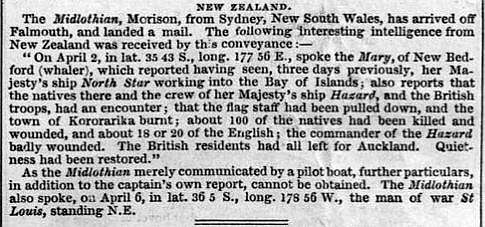
July 12th 1845


July 19th


Click here for the next Year of The Illustrated London News
Click here for the PREVIOUS Year of The Illustrated London News
Home Page - Year
Grid - Contact John - Join our Facebook Group