Between 1862 and 1864 the cotton districts of Lancashire and the industrial North experienced a prolonged and severe crisis that became known as the Cotton Famine.
The hardship was not caused by failure at home, but by events overseas. The American Civil War abruptly cut off supplies of raw cotton from the Southern States, upon which Britain’s textile industry was heavily dependent.
As mills reduced hours or closed altogether, vast numbers of spinners, weavers, and allied trades were thrown out of work. Entire towns built on cotton manufacture were left without their principal source of income.
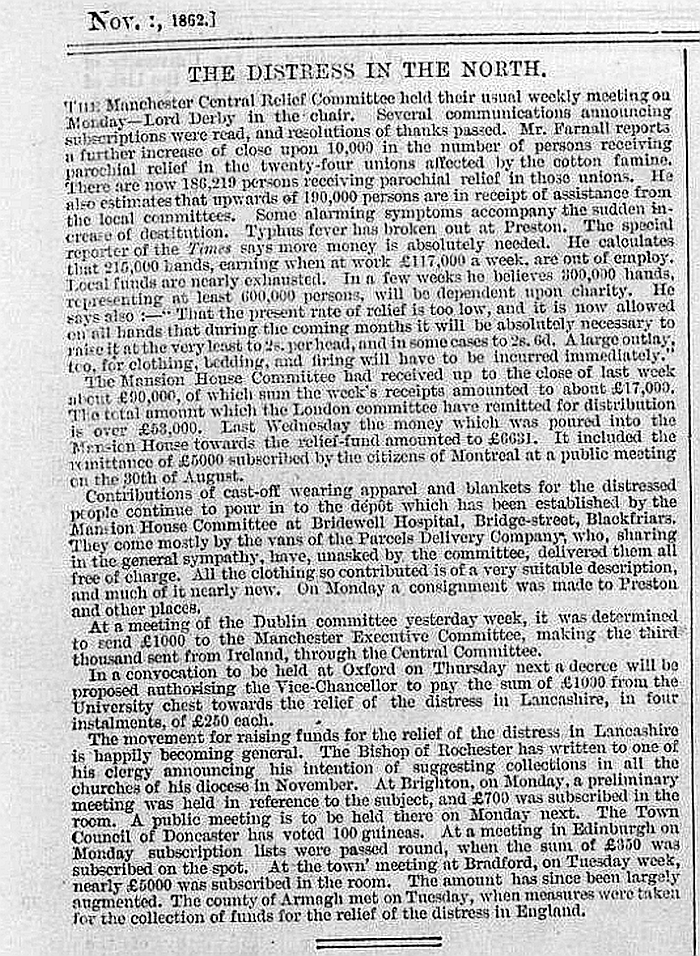
The Illustrated London News chronicled this unfolding disaster with striking regularity, frequently under the heading “Distress in the North.” Its reports described silent mills, crowded relief offices, and families surviving on charity and public assistance.
Alongside the suffering, the paper recorded an extraordinary response. Relief committees were formed, subscriptions raised across Britain and abroad, and public works organised to provide employment while preserving dignity and self-respect.
The ILN’s coverage offers a powerful contemporary record of how a distant war produced local catastrophe, and how Victorian society confronted one of the gravest industrial crises of the nineteenth century.
November 1st 1862
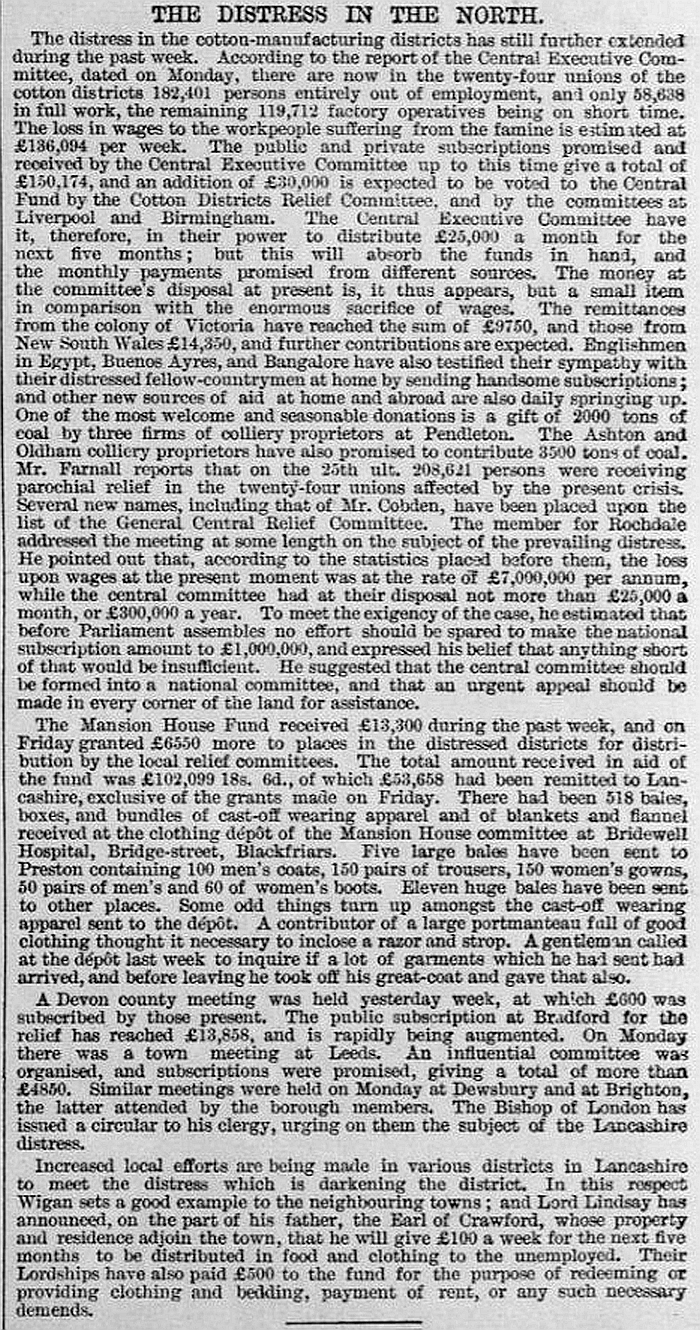
November 8th 1862
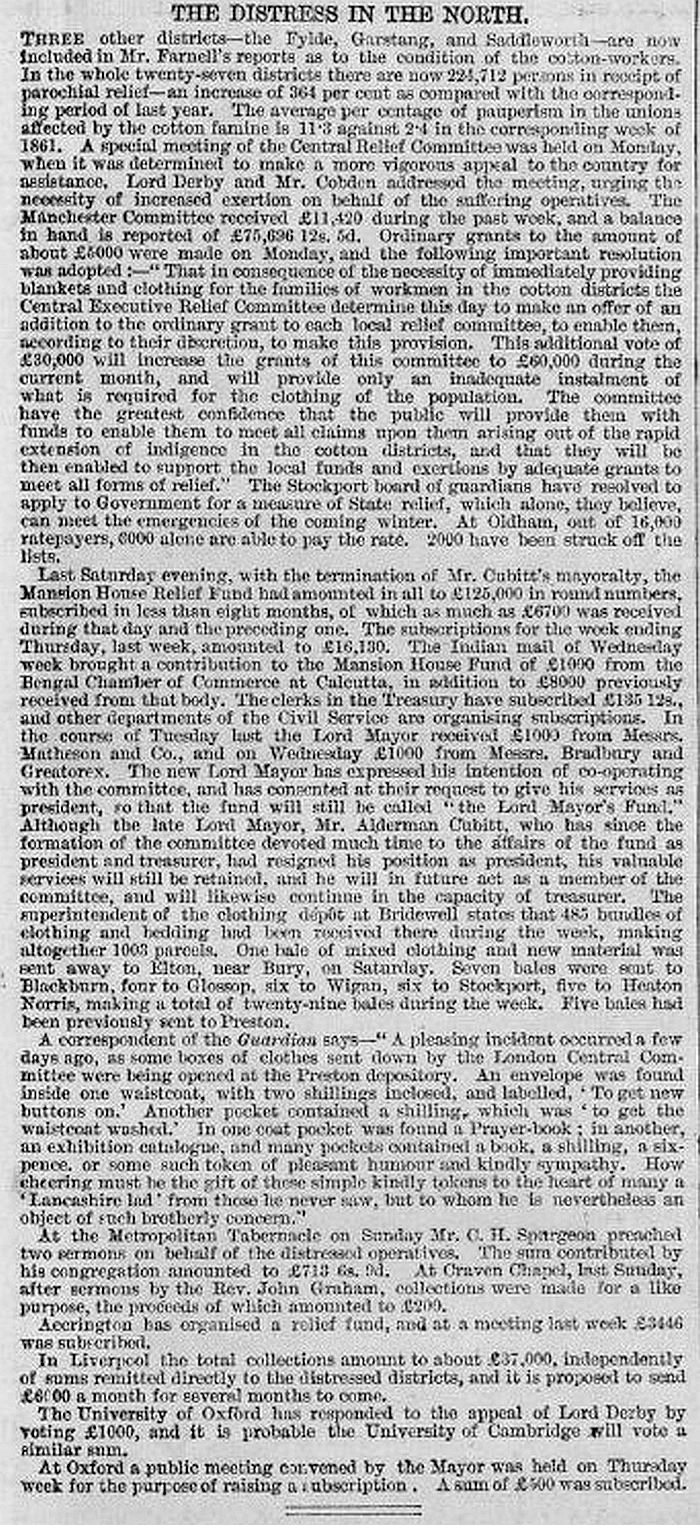
November 15th 1862

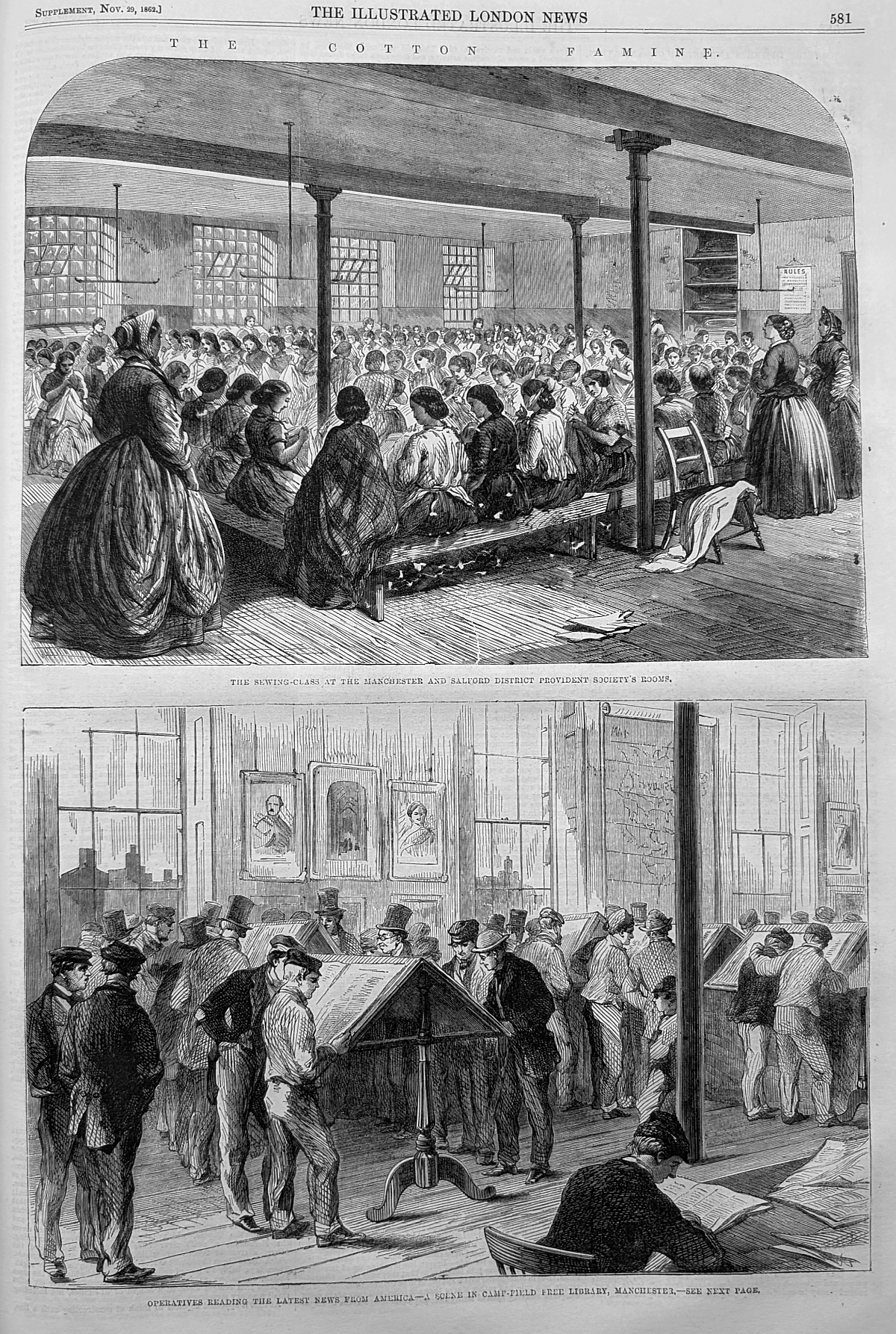
The cotton famine: Distributing tickets for bread, soup, meat, coal, etc., at the office of a district Provident society, Manchester

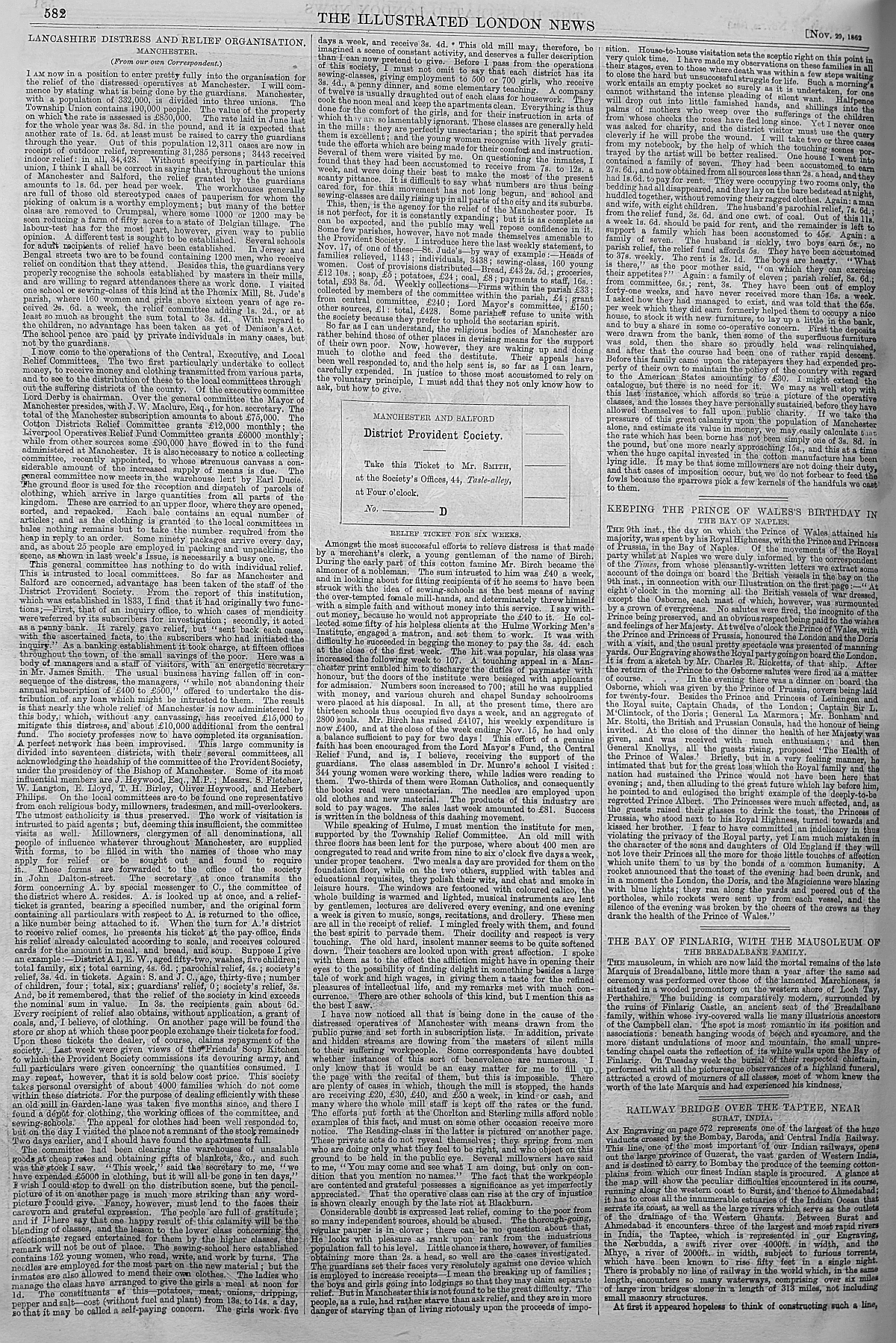
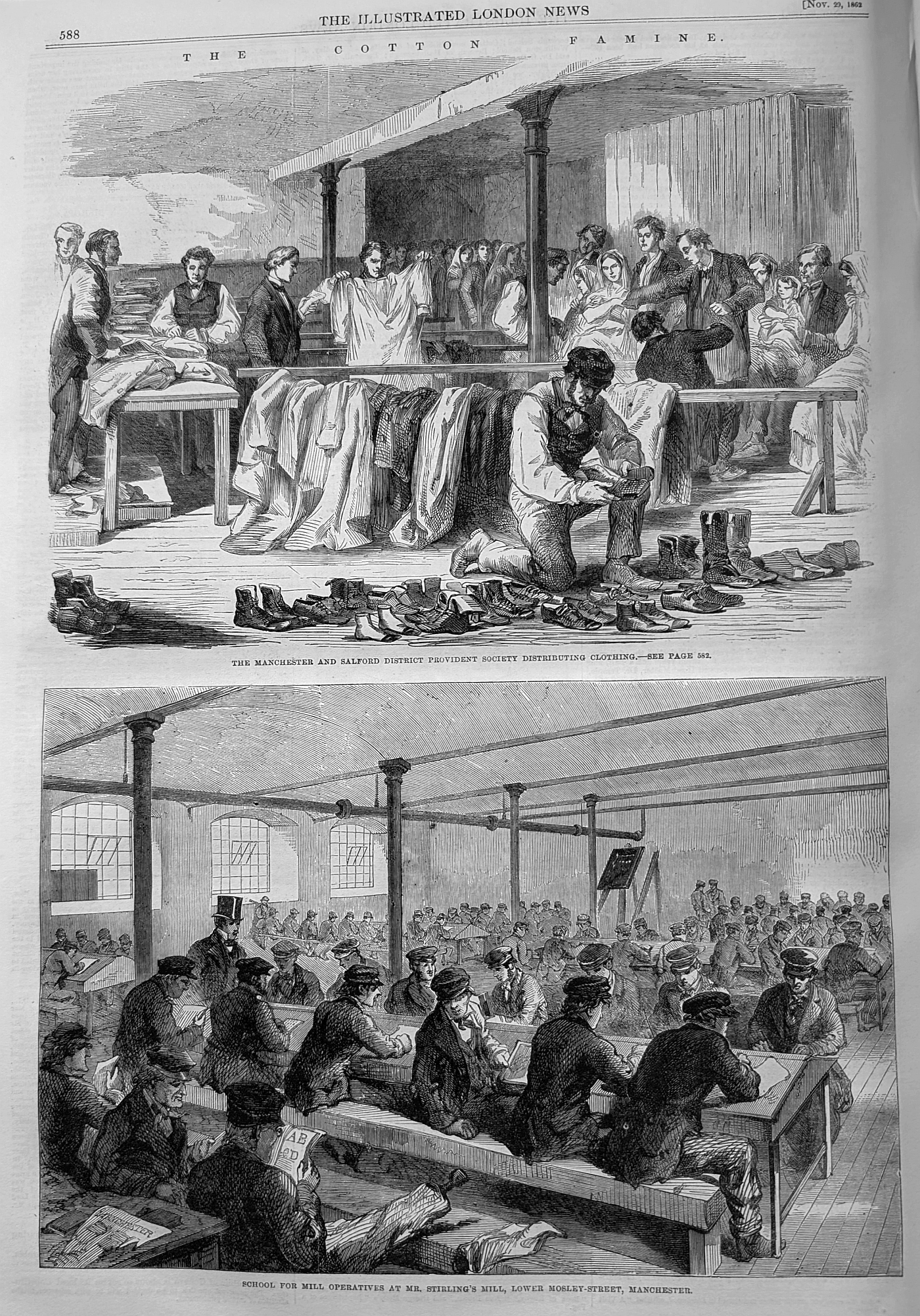
Lancashire distress amd relief organisation Nov 22
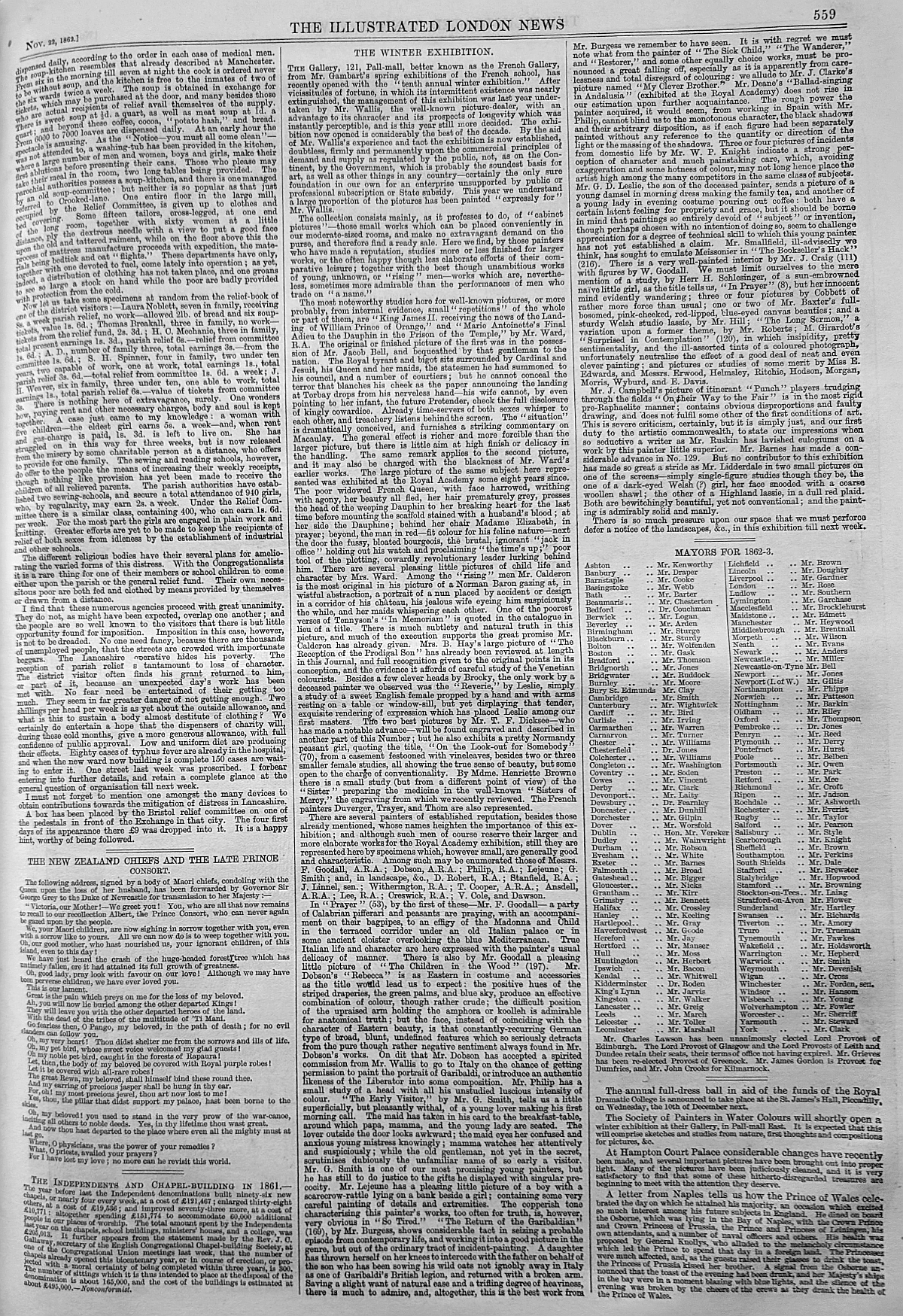
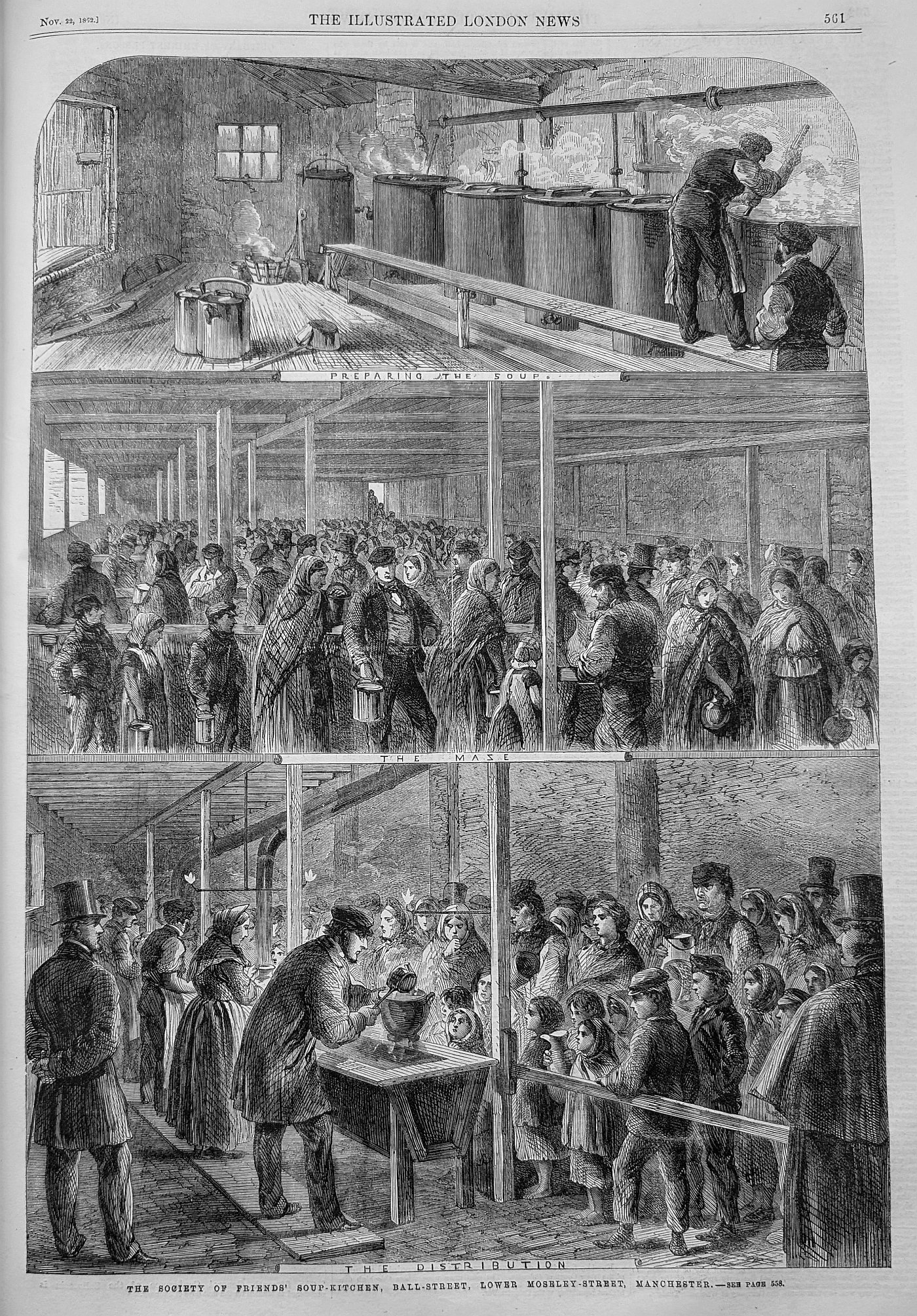
The scoety of Friends' soup-kitchen, Ball Street, Lower Moseley-street, Manchester

Receiving clothes at Bridewell Hospital, London, for the distressed operatives
Making up parcels of clothing at the industrial institution, Manchester
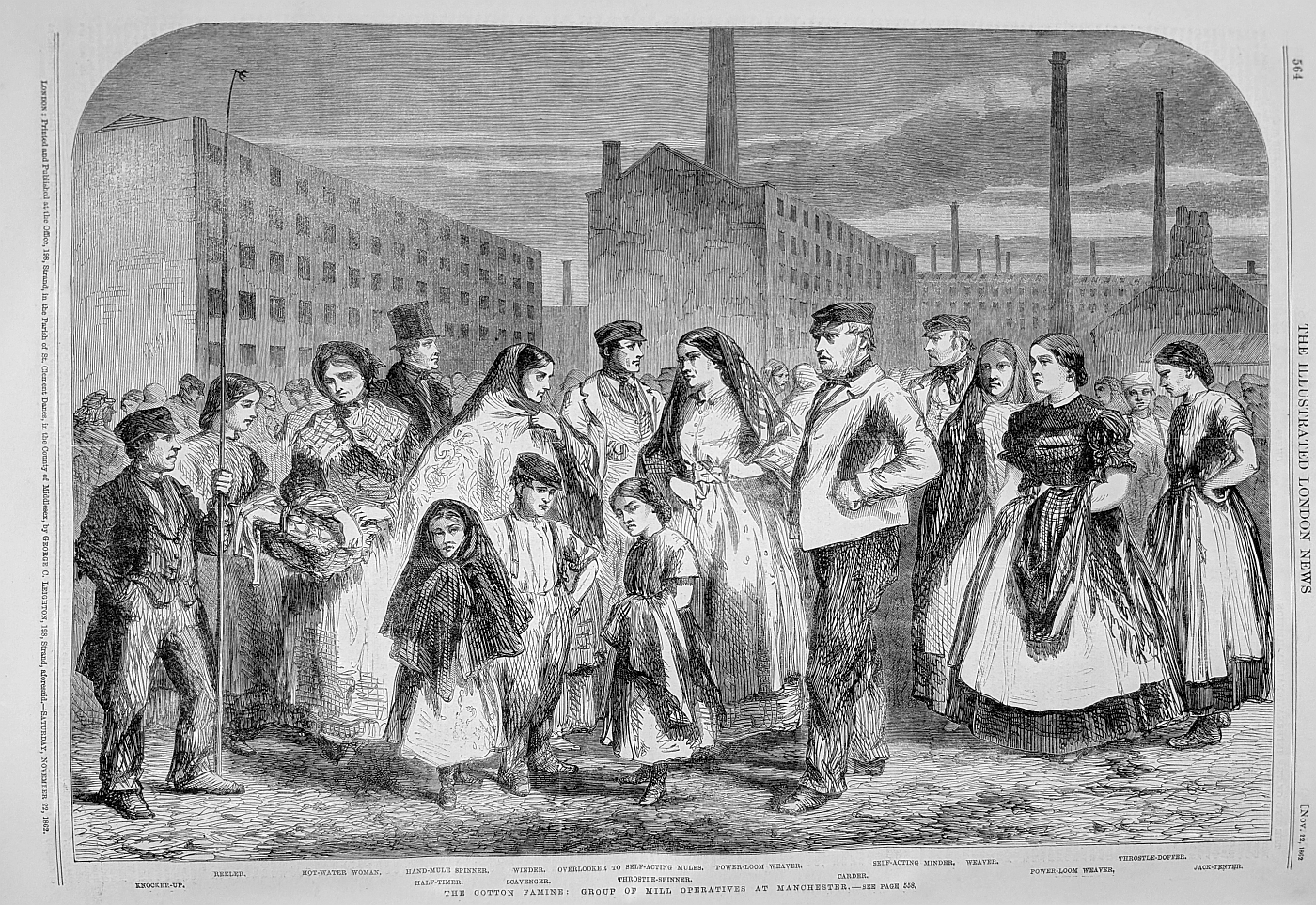
..................................Reeler..........Hot
water woman...Hand mule spinner...Winder.. Over looker ...Power loom weaver...............Self
acting minder, weaver........................Throstle-Doffer
......................Knocker up............................................................Half-timer...Scavenger................Throstle-spinner.................................Carder........................Powerloom
weaver....Jack-tenter
The Cotton Famine: Group of Mill Operatives at Manchester
The
Cotton Famine: Group of mill operatives at Manchester, 1862.
Lancashire textile workers are shown engaged in the many specialised
occupations of the cotton mill.
A Reeler in a cotton mill was an operative responsible
for transferring spun yarn from bobbins or cops onto
large revolving frames known as swifts,creating hanks or skeins.
This critical, often female-dominated, preparatory role involved managing yarn,
repairing broken threads, and removing completed hanks for subsequent dyeing or warping processes
The Carder in a cotton mill was a crucial worker responsible
for operating machinery that cleaned, disentangled,
and straightened raw cotton fibers to prepare
them for spinning and
was responsible for ensuring
that the machinery operated in perfect working order
The
Jack Tenter,
(or Jack-frame tenter) was a specific type of cotton mill operative,
typically a young woman or girl, responsible for operating the "jack frame"
or "roving frame". This machine was crucial in the preparatory process of cotton spinning,
as it took the loose, thick cotton strands (sliver) from the carding machine
and drew them out, twisted them slightly, and wound them onto bobbins for the spinning mules.
The Hand-mule Spinner was a highly skilled male operative
who oversaw the production of fine-quality cotton yarn
using a "hand mule" (which, despite the name, was powered by steam
for the main motions but controlled by hand for specific, complex actions).
Also kKnown as minders or "Barefoot Aristocrats," these workers
were central to the Lancashire textile industry,
managing large machines often exceeding 100 feet in length,
producing delicate threads for the luxury and export markets, such as the lace trade.
The Throstle Spinnerwas responsible for tending a "throstle frame,"
a spinning machine that produced cotton yarn through a continuous,
rather than intermittent, process.
The machine was named for the humming sound it made,
which resembled the song of a thrush (or "throstle" in local dialect)
Throstle Doffer, often a young boy or girl
a, typically young, textile worker responsible for removing
("doffing") full bobbins of spun yarn from the
throstle spinning machine and
replacing them with empty ones.
This essential, fast-paced, and often dangerous job was
usually performed by children or young adults, frequently barefoot,
to keep machines running continuouslyl.
Half-timers, were children aged 8 to 13 who combined factory labour
with school attendance.
Under the Factory Acts of 1844 and subsequent regulations,
these children worked a maximum of six and a half hours a day
(or ten hours on alternate days) to allow for mandated schooling.
By 1860, they were integral to the textile workforce, often employed as piecers or sweepers.
A Scavenger was a child operative, often as young as four to eight years old,
employed to clean the machinery and floor area,
particularly underneath the spinning mules.
They were considered the lowest, most vulnerable,
and lowest-paid workers in the textile industry, primarily in Britain,
responsible for collecting loose, valuable cotton debris while machines remained in motion
The Power-loomWeaver combined warp and weft supplied by the spinners to produce cloth.
Other roles included the Hot-water Woman, who supplied
mill-hands, who come from a distance, with
jugs of hot water for their breakfasts and dinners
The Knockers-up,
whose task was to wake factory operatives in the morning, receiving
twopence a week from each person they roused.
Supervision was carried out by Overlookers, including the Overlooker to
the Self-acting Mules, who oversaw the machinery in that department, and
the Power-loom Overlooker, responsible for the operation of the
power-loom rooms.
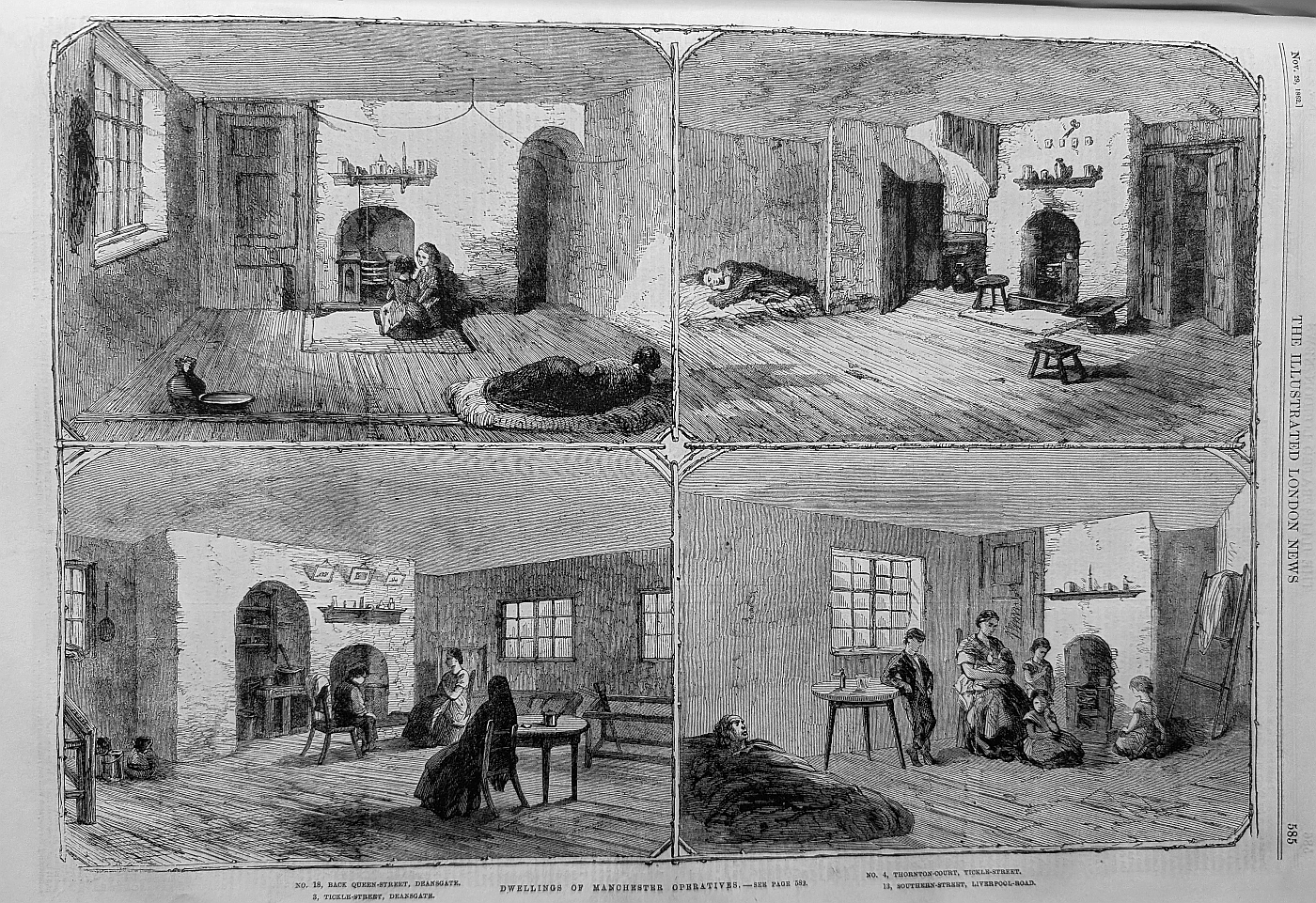
No. 18 Back Queen street, Deansgate ......................................................................................................................................................................No.
4 Thornton Court, Tickle street
3 Tickle Street, Deansgate.................................................................................Dwellings
of Manchester operatives ..............................................13,
Southern Street, Liverpool Road

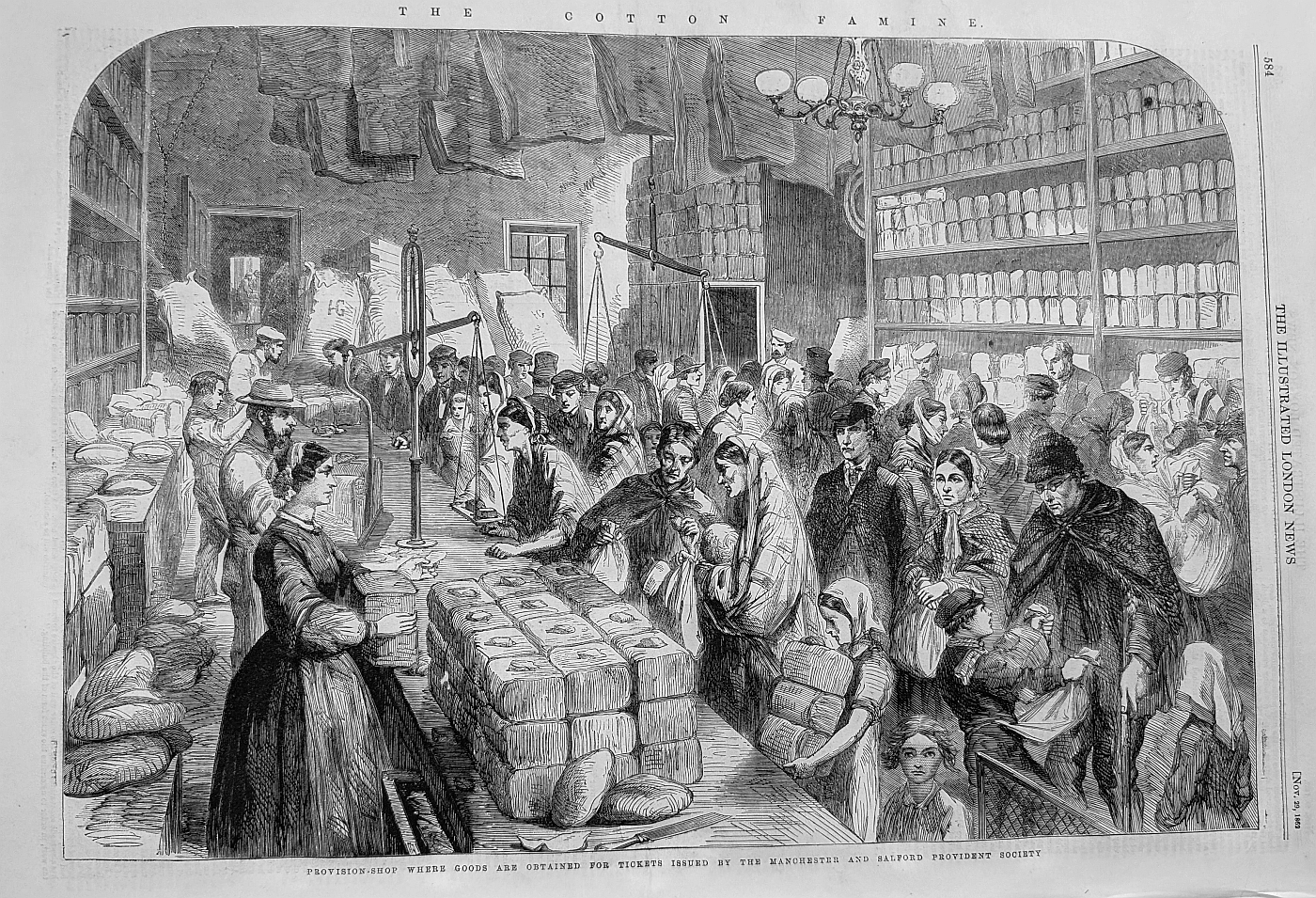
Provision Shop where goods are obtained for tickets issued by the Manchester and Salford provident Society Nov 29 1862
This website is completely free to use—no charges, no subscriptions, no catch.
If you find it helpful or enjoyable, and if it’s within your means, please consider making a donation to the NSPCC to support their work protecting children.
Your generosity is entirely optional—your experience here will remain free no matter what.
You can also fundraise for the NSPCC and get a free pack of tips and materials.