Spanish Civil War 1936–1939
Part 1
(dates below refer to publication dates)
February 29th to August 1st 1936
Illustrated London News Collection
A curated collection of ILN reports and images covering the Spanish Civil War — political background, major battles and key personalities.
The Spanish Civil War (1936–1939) began with a military uprising against the Republican government in July 1936. The conflict rapidly polarised Spanish society and drew international attention — the Nationalists (led by Francisco Franco) were supported by Fascist Italy and Nazi Germany, while the Republicans received aid from the Soviet Union and volunteers from the International Brigades. The war reshaped Spain and had wide-reaching cultural and political consequences across Europe.
On this page you will find ILN scans, captions, short biographies, and selected contextual notes to help readers understand the events and principal actors.
Key figures (brief)
- Francisco Franco — Leader of the Nationalist rebels, later head of state of Spain.
- Manuel Azaña — President of the Spanish Republic (during key periods of the war).
- Dolores Ibárruri (La Pasionaria) — Prominent Republican speaker and symbol of Republican resistance.
- International Brigades — Volunteers from many countries who fought for the Republic.
- General Emilio Mola — One of the main plotters and Nationalist commanders (died 1937).
- Buenaventura Durruti — Anarchist leader who played a role on the Republican side.
(Names and roles are documented in ILN coverage and standard histories of the conflict.)
Key events — Feb to July 1936
-
16 Feb 1936 — Popular Front election victory
Left-wing coalition wins power; political tensions escalate. -
March–April — Strikes & land occupations
Supporters of the left push for rapid reform; violence rises between political groups. -
April 1936 — Manuel Azaña becomes Prime Minister
Conservatives alarmed by renewed anti-clerical measures and military reshuffling. -
12 July — Assassination of police officer José Castillo
A left-leaning officer killed by far-right extremists. -
13 July — Retaliatory killing of José Calvo Sotelo
A leading monarchist politician, murdered by security personnel — turning point. -
17–18 July — Military uprising begins in Spanish Morocco
Army revolt spreads to mainland Spain → Civil War begins. -
Who Were the Rebels?
The Rebels — later known as the Nationalists — were led by General Francisco Franco and other senior officers who rose in July 1936 against Spain’s elected Popular Front government, the left-wing administration of the Second Spanish Republic. Their ranks included much of the regular army, particularly units from Spanish Morocco, together with monarchists, conservatives, and members of the Falange (Spain’s fascist movement). They received crucial support from Nazi Germany, Fascist Italy, and Portugal.The opposing Republicans comprised socialists, communists, anarchists, and regional nationalists, supported by the Soviet Union and the International Brigades of foreign volunteers.

The electoral victory of the left in Spain: Rioting and arson March 21st

A trail of Arson through Spain March 21st
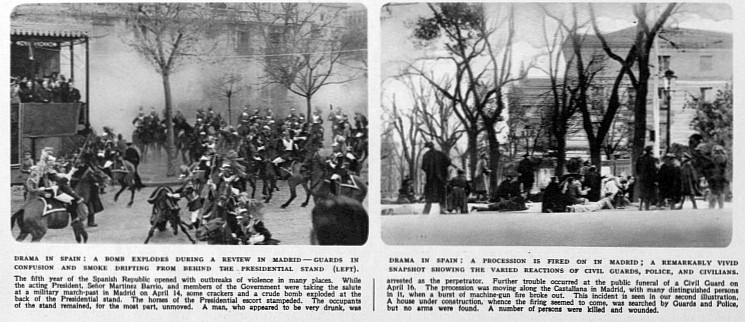
A bomb goes off in Madrid April 25th
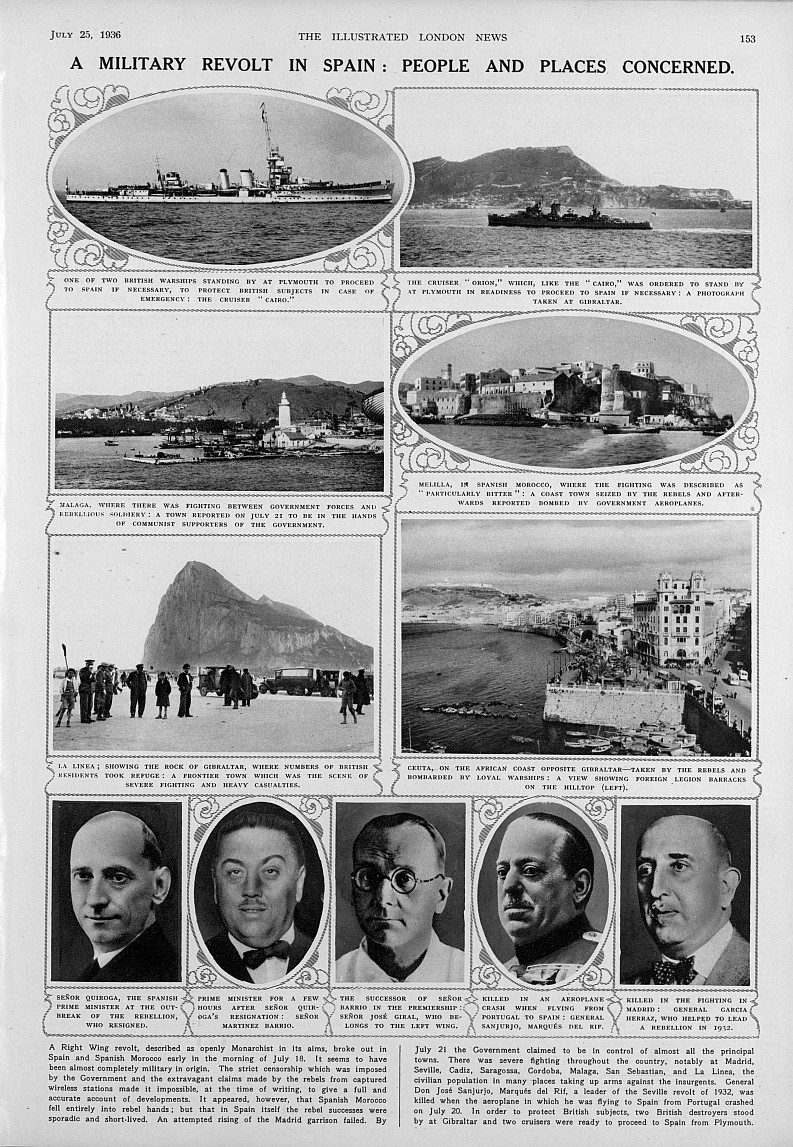
A military revolt in Spain: People and places concerned July 25th

Civil war in Spain: Armed women fighters; and foreign refugees

Civil war in Spain: Toledo rebels beaten by the government August 1st

The civil war in Spain: The spanish fleet and its action against the rebels August 1st

Civil war in Spain: Gibraltar as a haven of refuge August 1st

Civil war in Spain: Fierce fighting in the streets of Barcelona
Short historical note
The war was fought on multiple fronts and combined conventional battles with sieges (Guernica, Madrid, Bilbao) and aerial bombardment (notably Guernica in 1937). It ended in early 1939 with a Nationalist victory and Franco's long rule. The conflict was a testing ground for new military tactics and an ideological prelude to World War II.
- Preston, Paul. The Spanish Civil War.
- Beevor, Antony. The Battle for Spain.
- Contemporary ILN issues (scans on this site).